Research · Thyroid Radiofrequency Ablation
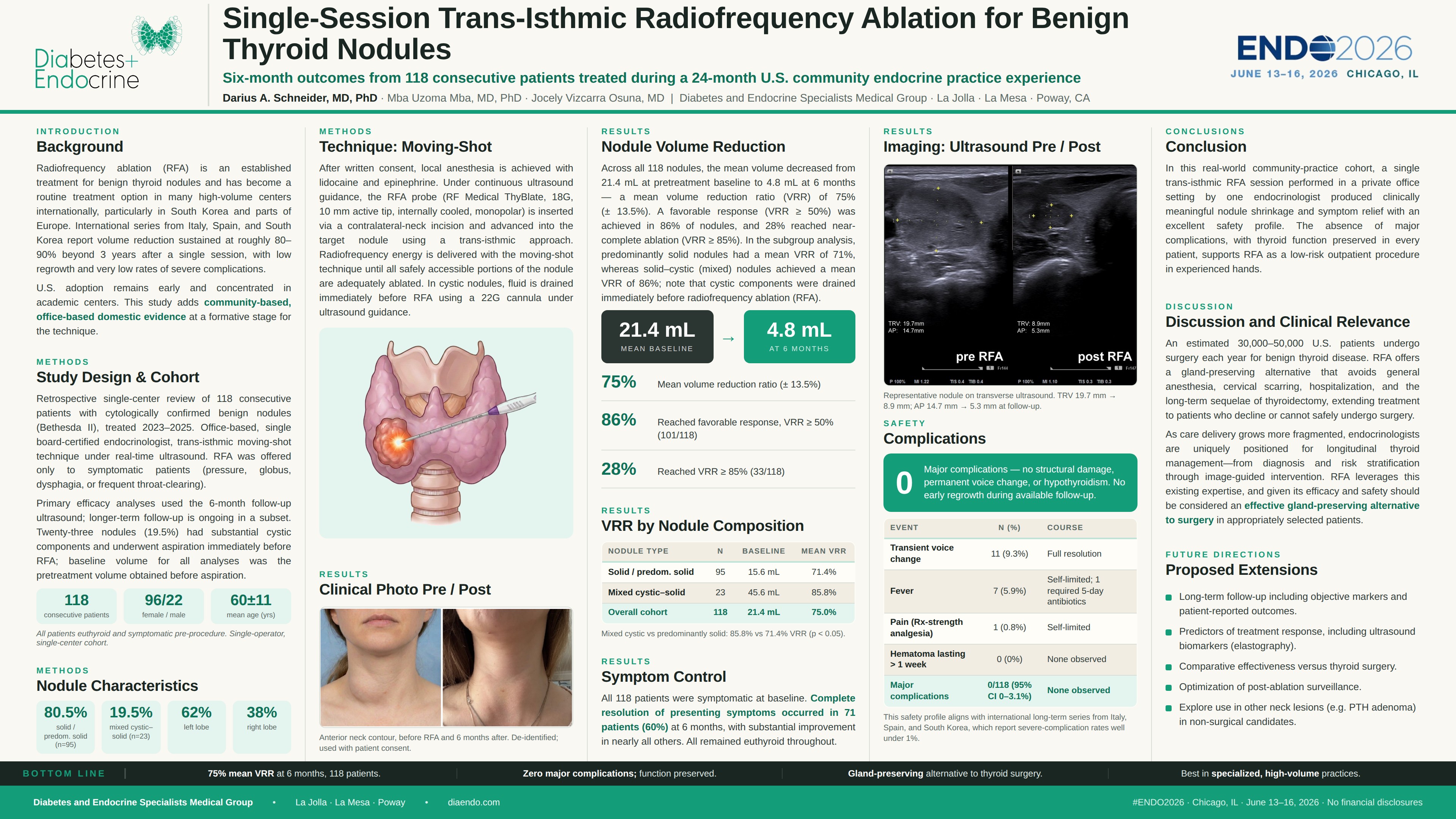
Six-month results of single-session radiofrequency ablation for benign thyroid nodules in a U.S. community endocrine practice, presented at ENDO 2026, the Endocrine Society's annual meeting.
| Measure | Result at 6 months |
|---|---|
| Patients (consecutive, cytologically benign nodules) | 118 |
| Mean nodule volume | 21.4 mL before, 4.8 mL after |
| Mean volume reduction ratio (VRR) | 75% (±13.5%) |
| Complete resolution of presenting symptoms | 71 of 118 (60%) |
| Major complications | 0 of 118 (0%; 95% CI 0–3.1%) |
We analyzed 118 consecutive patients with cytologically benign thyroid nodules who underwent a single session of radiofrequency ablation in our practice. All patients were symptomatic at baseline.
Eligibility. Every nodule had a benign biopsy result before treatment. Ablation was offered for nodules causing pressure, swallowing difficulty, visible neck fullness or other symptoms, consistent with published guidance that ablation is reserved for benign nodules causing symptoms or cosmetic concern.
Technique. Procedures were performed in the office under local anesthesia using a trans-isthmic approach and an internally cooled monopolar electrode (RF Medical ThyBlate, 18-gauge, 10 mm active tip). In mixed cystic–solid nodules, the cystic component was drained immediately before ablation.
Outcomes measured. Nodule volume by ultrasound at baseline and six months, expressed as the volume reduction ratio (VRR); favorable response (VRR of at least 50%) and near-complete response (VRR of at least 85%); resolution of presenting symptoms; and all complications and side effects.
| Nodule type | Patients | Mean baseline volume | Mean VRR at 6 months |
|---|---|---|---|
| Solid or predominantly solid | 95 | 15.6 mL | 71.4% |
| Mixed cystic–solid | 23 | 45.6 mL | 85.8% |
| All nodules | 118 | 21.4 mL | 75.0% |
101 of 118 patients (86%) reached a favorable response, and 33 of 118 (28%) reached near-complete ablation. Mixed cystic–solid nodules responded better than predominantly solid nodules (85.8% vs 71.4% mean VRR, p < 0.05).
71 of 118 patients (60%) reported complete resolution of their presenting symptoms by six months, with improvement in most of the others.
There were no major complications: no permanent voice change, no structural injury, and no hypothyroidism caused by the procedure. No early regrowth was seen during available follow-up (0 of 118).
| Side effect | Patients | Course |
|---|---|---|
| Transient voice change | 11 (9.3%) | Resolved |
| Fever | 7 (5.9%) | Self-limited; one patient received a 5-day course of antibiotics |
| Pain requiring prescription-strength analgesia | 1 (0.8%) | Resolved |
| Hematoma lasting more than one week | 0 | — |
| Study | Setting | Patients / nodules | Volume reduction |
|---|---|---|---|
| This cohort (ENDO 2026) | U.S. community endocrine practice, single session | 118 patients | Mean 75% at 6 months |
| Kandil et al., Ann Surg 2022 | U.S. multi-institutional prospective cohort | 233 nodules | Median 73% at 6 months; 76% at 12 months |
| Aljammal et al., J Endocr Soc 2025 | U.S. multi-center endocrinology practices | 240 patients, 275 nodules | Median 63.5% at ~6 months |
| Jung et al., Korean J Radiol 2018 | Prospective multicenter, trans-isthmic approach | 345 patients | Mean 80.3% at 12 months; 84.3% at 24 months |
Our six-month results fall within the range reported by other U.S. centers. Means and medians are not directly interchangeable, and patient selection differs between studies. Published long-term series show that most of the shrinkage achieved in the first year is maintained, but some nodules regrow over several years, and a minority of patients are re-treated: in an Italian multicenter study, 20% of RFA-treated nodules showed regrowth and 12% were re-treated over five years.
Individual results vary and are not guaranteed.
If a benign nodule is causing pressure, swallowing difficulty or visible fullness, a single office-based RFA session shrinks most nodules substantially within six months while preserving normal thyroid function. Mixed cystic–solid nodules tend to respond especially well. Very large, diffuse or substernal goiters are often better treated with surgery, and mostly fluid-filled cysts may respond to ethanol ablation first.
Start with an accurate diagnosis: see how thyroid nodules are evaluated, compare goiter treatment options, or read what thyroid RFA costs.
Schneider DA, Mba UM, Vizcarra Osuna J. Single-Session Trans-Isthmic Radiofrequency Ablation for Benign Thyroid Nodules: Six-Month Outcomes from 118 Consecutive Patients in a U.S. Community Endocrine Practice. ENDO 2026, the Endocrine Society Annual Meeting, Chicago, IL, June 13–16, 2026. View the poster.
The investigators: Darius A. Schneider, MD, PhD and Mba Uzoma Mba, MD, PhD, endocrinologists at Diabetes & Endocrine Specialists, with Jocely Vizcarra Osuna. Patients interested in endocrine research can learn about current studies at EndoTrials Clinical Research Center.
Papini E, Monpeyssen H, Frasoldati A, Hegedüs L. 2020 European Thyroid Association Clinical Practice Guideline for the Use of Image-Guided Ablation in Benign Thyroid Nodules. Eur Thyroid J. 2020;9(4):172–185. doi:10.1159/000508484
Orloff LA, Noel JE, Stack BC, et al. Radiofrequency ablation and related ultrasound-guided ablation technologies for treatment of benign and malignant thyroid disease: an international multidisciplinary consensus statement. Head Neck. 2022;44(3):633–660. doi:10.1002/hed.26960
Sinclair CF, Baek JH, Hands KE, et al. General Principles for the Safe Performance, Training, and Adoption of Ablation Techniques for Benign Thyroid Nodules: An American Thyroid Association Statement. Thyroid. 2023;33(10):1150–1170. doi:10.1089/thy.2023.0281
Mauri G, Pacella CM, Papini E, et al. Image-Guided Thyroid Ablation: Proposal for Standardization of Terminology and Reporting Criteria. Thyroid. 2019;29(5):611–618. doi:10.1089/thy.2018.0604
Kandil E, Omar M, Aboueisha M, et al. Efficacy and Safety of Radiofrequency Ablation of Thyroid Nodules: A Multi-institutional Prospective Cohort Study. Ann Surg. 2022;276(4):589–596. doi:10.1097/SLA.0000000000005594
Aljammal J, Jasim S, Alahdab F, et al. Predictors of Initial Response of Thyroid Nodules Treated With RFA, a Multi-Endocrinology Centers Experience From the United States. J Endocr Soc. 2025;9(7):bvaf077. doi:10.1210/jendso/bvaf077
Jung SL, Baek JH, Lee JH, et al. Efficacy and Safety of Radiofrequency Ablation for Benign Thyroid Nodules: A Prospective Multicenter Study. Korean J Radiol. 2018;19(1):167–174. doi:10.3348/kjr.2018.19.1.167
Bernardi S, Giudici F, Cesareo R, et al. Five-Year Results of Radiofrequency and Laser Ablation of Benign Thyroid Nodules: A Multicenter Study from the Italian Minimally Invasive Treatments of the Thyroid Group. Thyroid. 2020;30(12):1759–1770. doi:10.1089/thy.2020.0202
Chung SR, Suh CH, Baek JH, et al. Safety of radiofrequency ablation of benign thyroid nodules and recurrent thyroid cancers: a systematic review and meta-analysis. Int J Hyperthermia. 2017;33(8):920–930. doi:10.1080/02656736.2017.1337936
Written by Darius A. Schneider, MD, PhD, board-certified endocrinologist (ECNU-certified in neck ultrasound). Reviewed October 2026.
We review your ultrasound and biopsy, perform our own ultrasound, and tell you plainly whether ablation, surgery or simply watching is the better choice.
Request an evaluation